Coffee and food arrive together
A round often contains both. Without a shared order number, the kitchen does not know what the bar is already working on.
 BierblockDELogin
On a Sunday morning, several tables order coffee, drinks and a warm dish at almost the same time. Bierblock takes the round at the table; the bar and kitchen see their items separately under the same order number. A food rush is not a measure of waiting time: how quickly something arrives depends on the team, preparation and crowd. Test the menu, serving points and flow before the morning gathering with a test round.
The Problem
The morning gathering is short; the paths between table, bar and kitchen still stay separate.
A round often contains both. Without a shared order number, the kitchen does not know what the bar is already working on.
Several tables order in the same window; handwritten slips are duplicated or become unreadable faster.
Without a shared record, it is hard to say how much coffee and how many rolls were actually ordered.
The Solution
The flow stays small: prepare the menu and two serving points, take one round, work it separately, review quantities.
Coffee and drinks go to the bar, the few dishes to the kitchen. Each product is assigned to a serving point; the team defines this assignment, the software does not distribute it automatically.
Drink managementChoose the table, collect coffee, juice, a roll and a warm dish in one order, check the quantity and send it. The round stays together under one order number.
Each serving point sees only its items, both carry the same order number. Open, In progress and Ready are set per item; ready means prepared, not served or paid.
Kitchen managementThe product report shows recorded order quantities. It is not a stock count, a checkout total or a measure of waiting time; compare it with remaining stock and purchases.
Free toolsAt Tisch 41, two coffees, one orange juice, two sausage rolls and one Kaspress-Knödel are collected in one order. The cart shows six items and €23.00. Sending creates one order number for both serving points.
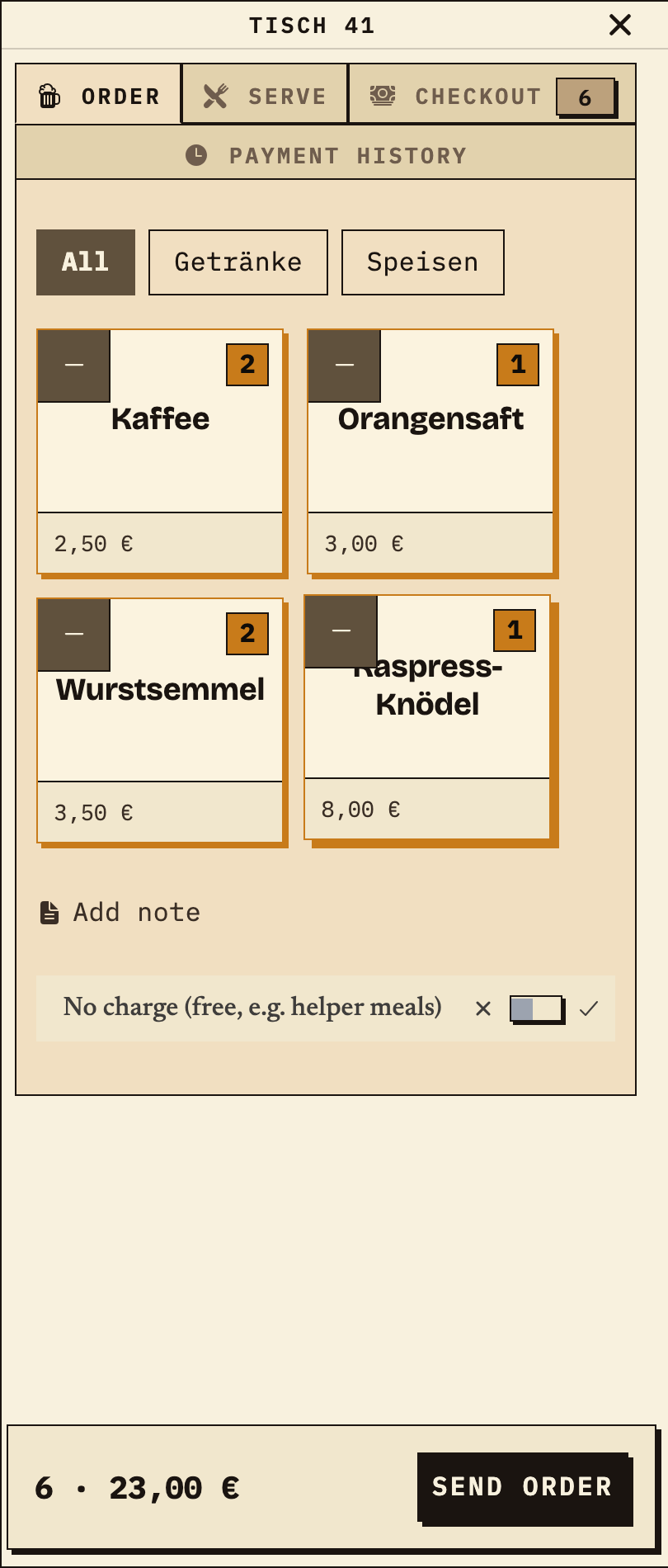
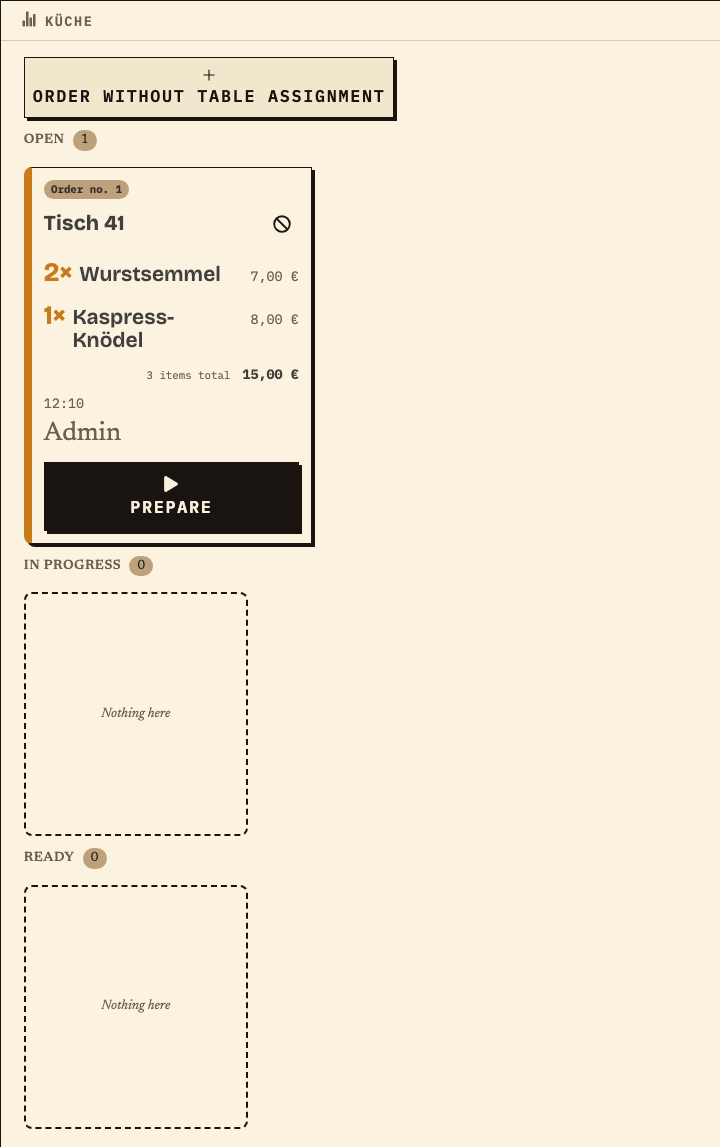
The kitchen shows only the two sausage rolls and the Kaspress-Knödel from order no. 1. The bar does not see these dishes; the shared number remains visible.
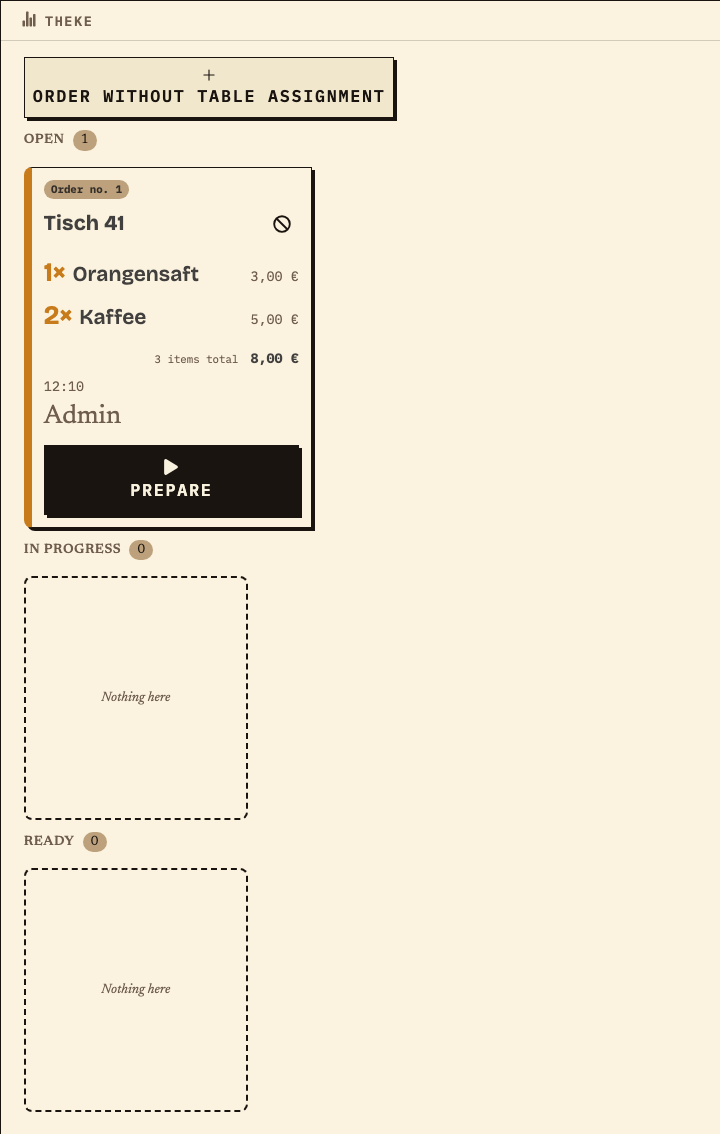
The bar shows only the two coffees and the orange juice from order no. 1. Both serving points work separately; nobody has to tick off the other serving point’s items.
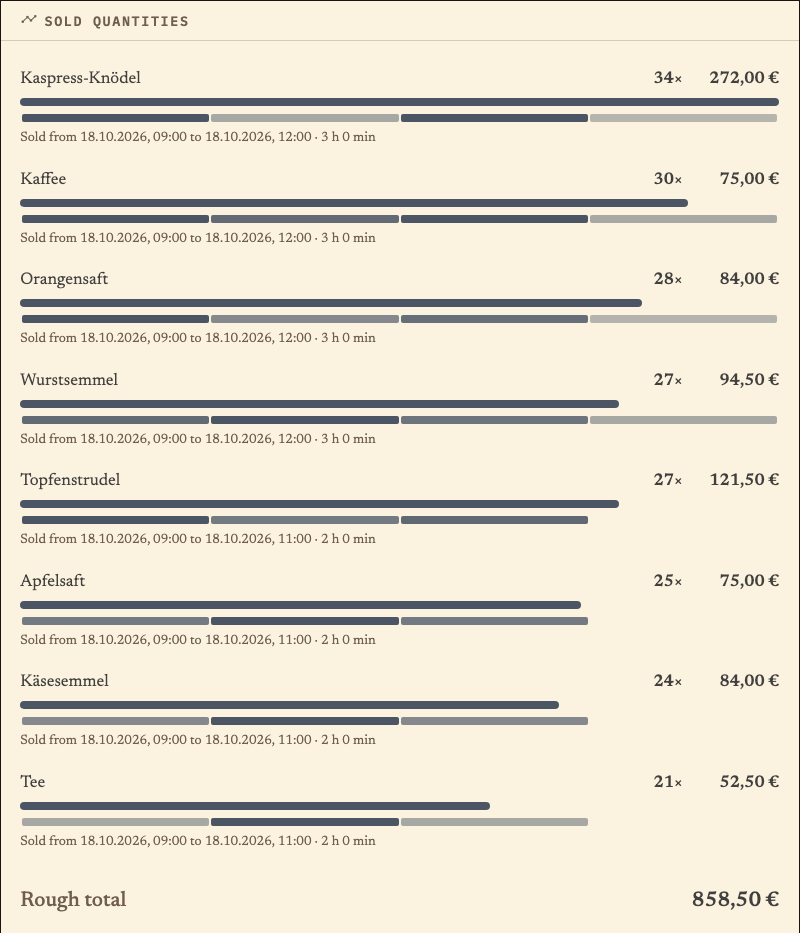
For the review we created a separate test run with 36 rounds and the full morning-gathering menu; example round no. 1 is included. The upper bar shows the share of total quantity, the timeline below shows the hours 09:00–12:00, with darker segments meaning more orders in that hour. The figures are test data; they measure neither waiting time nor consumption or profit.
Work material
Fill in the list before the event and go through it with the team. The right-hand column names the expected result.
Example (test data): coffee and orange juice at the bar, sausage rolls and Kaspress-Knödel at the kitchen. The values are a pattern, not a measure of waiting time or capacity.
| Step or entry | Serving point, products and check | Result |
|---|---|---|
Scroll horizontally to see the full table.
Entries are not saved. Print the completed list before reloading or note the values separately.
Benefits at a glance
A fictional small club offers coffee and orange juice at the bar plus sausage rolls and Kaspress-Knödel at the kitchen. Before the event, the responsible person assigns the four products to the two serving points and tests a mixed round at Tisch 41. During the short rush, helpers take one round per table; the kitchen sees only the dishes, the bar only the drinks, both with the same order number. A named person answers questions about sold-out items. Afterwards, the team compares recorded order quantities with remaining stock and purchase notes. A food rush is not a measure of waiting time; the software does not distribute load automatically. With a single serving point and no handover, the existing paper process may be enough. All names and prices are test data.
Frequently asked questions
Everything about setup, usage and costs.
Take a mixed round at one table and check it at the bar and kitchen. The public demo is free; your own demo events are limited to 20 orders per event.
Start without an account. Register to save. Your own demo events allow up to 20 test orders.
See pricing