Pick one task
Choose a task that returns at the next festival and name one person who owns the trial. Five parallel changes cannot be judged.
Open the task comparison for club software BierblockDELogin
Pick one recurring task, observe how it works today, test one complete order with the team that will run it, and decide afterwards. The grid records the problem, observation, trial, owner and decision. Bierblock is only the test case for the order path between kitchen and bar; membership, finances and communication stay in their existing tools.
The Problem
The number of tools does not decide success; whether a change works in the real workflow does. Three conditions make the difference.
Choose a task that returns at the next festival and name one person who owns the trial. Five parallel changes cannot be judged.
Open the task comparison for club softwareRecord what happens today: how often people ask, which items arrive at the wrong station, how the handover works. Without a baseline there is nothing to compare.
A sceptical helper should take the order and set the status themselves. A demonstration by the project lead convinces nobody.
The Solution
Keep the trial small: one task, one shift, one team. Bierblock can carry this trial for the order path; the method works with any suitable tool.
Fix the task, time window, team and success criteria before the test. One evening or shift is enough for a meaningful observation.
Count questions, wrongly routed items and duplicate entries in a comparison shift. Note only what you actually saw.
One mixed order at a table, one meal at the kitchen, one drink at the bar. The team operates it; a second person observes.
Compare the observation with your criteria. Decide together: repeat, adjust or stop. A failed trial is a result, not a mistake.
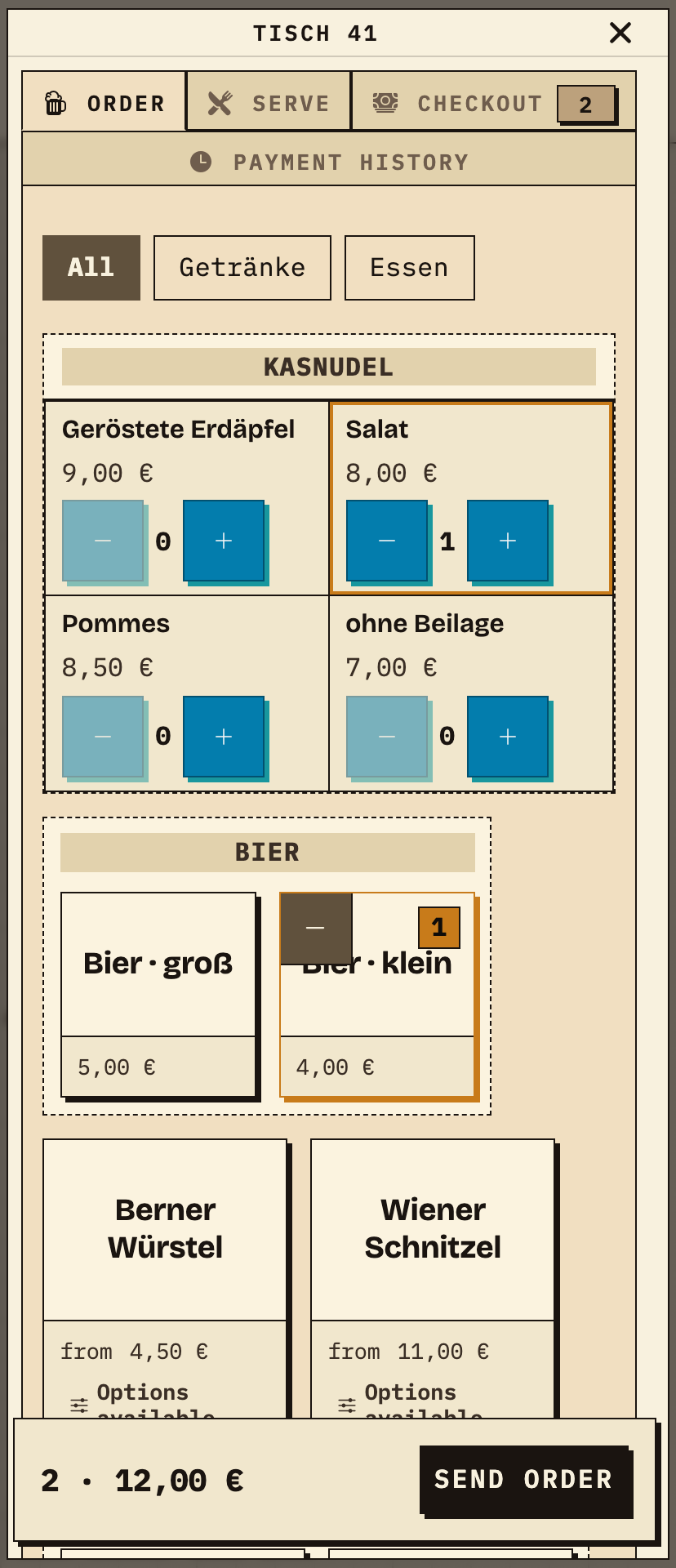
At table 41 the helper orders one small beer and one Kasnudel salad. The basket shows 2 items and 12.00 €. The order is sent once, so both stations work from the same order number.
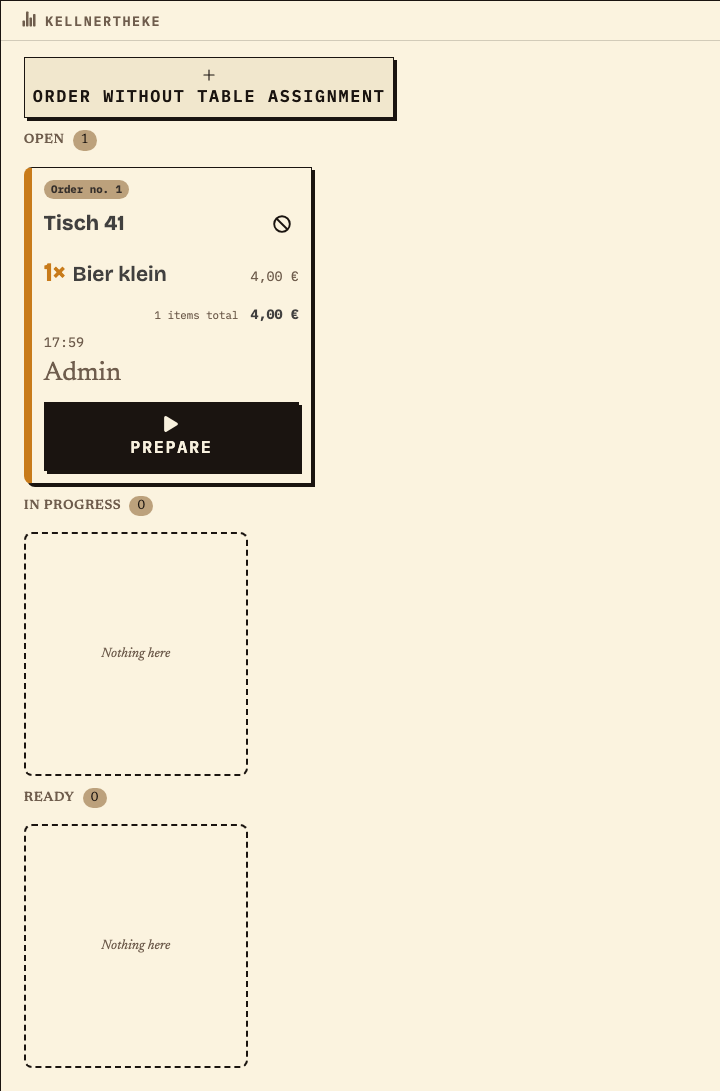
The bar monitor shows only the drink item under order number 1. The status is Open. The kitchen receives the food item under the same order number.
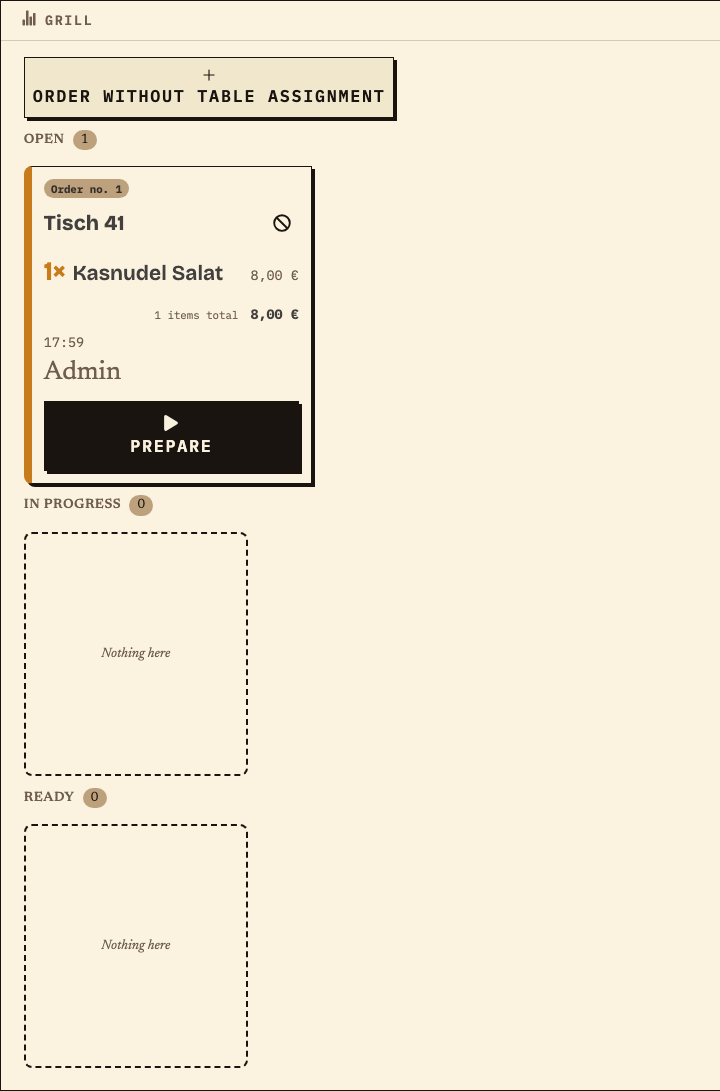
The grill monitor shows only the salad under order number 1. The bar and kitchen therefore work from the same order but see only their assigned items.
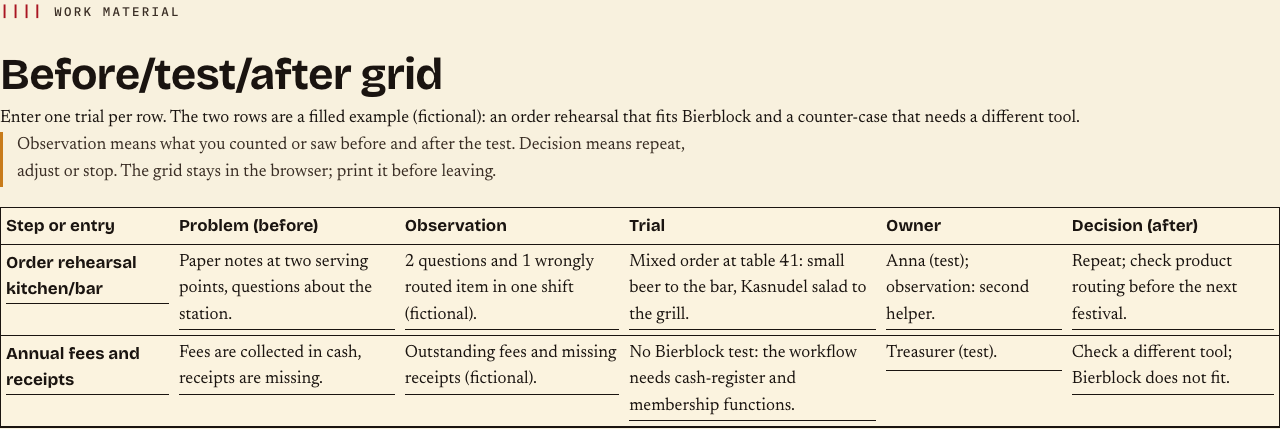
The grid holds one trial per row: problem, observation, trial, owner and decision. The screenshot shows the printed version with the order rehearsal and a counter-case that needs a different tool.
Work material
Enter one trial per row. The two rows are a filled example (fictional): an order rehearsal that fits Bierblock and a counter-case that needs a different tool.
Observation means what you counted or saw before and after the test. Decision means repeat, adjust or stop. The grid stays in the browser; print it before leaving.
| Step or entry | Problem (before) | Observation | Trial | Owner | Decision (after) |
|---|---|---|---|---|---|
Scroll horizontally to see the full table.
Entries are not saved. Print the grid before leaving the page.
Benefits at a glance
A club observes two questions and one wrongly routed item on Friday. On Saturday the team tests a mixed order at table 41: small beer (4.00 €) to the bar, Kasnudel salad (8.00 €) to the grill, total 2 · 12.00 €. A helper who is sceptical about the tool takes the order; a second person observes taking, stations and handover. After the shift the team compares the questions with the previous evening and decides: sharpen the product routing, repeat the test at the next festival. The club deliberately does not test its second task – annual fees and receipts – with Bierblock, because that needs cash-register and membership functions. All figures are a fictional example, not a reference.
Frequently asked questions
Everything about setup, usage and costs.
The grid follows the Plan–Do–Study–Act (PDSA) pattern. The sources describe the approach in general; they are not a requirement for your festival and not legal or tax advice. Editorial responsibility: Bierblock editorial team, review date 18 October 2026.
Ready?
Open the public demo to explore order taking, the kitchen and the bar. No account is needed. To prepare your own setup, start a test event afterwards.
Start without an account. Register to save. Your own demo events allow up to 20 test orders.
See pricing